The Waking Dream
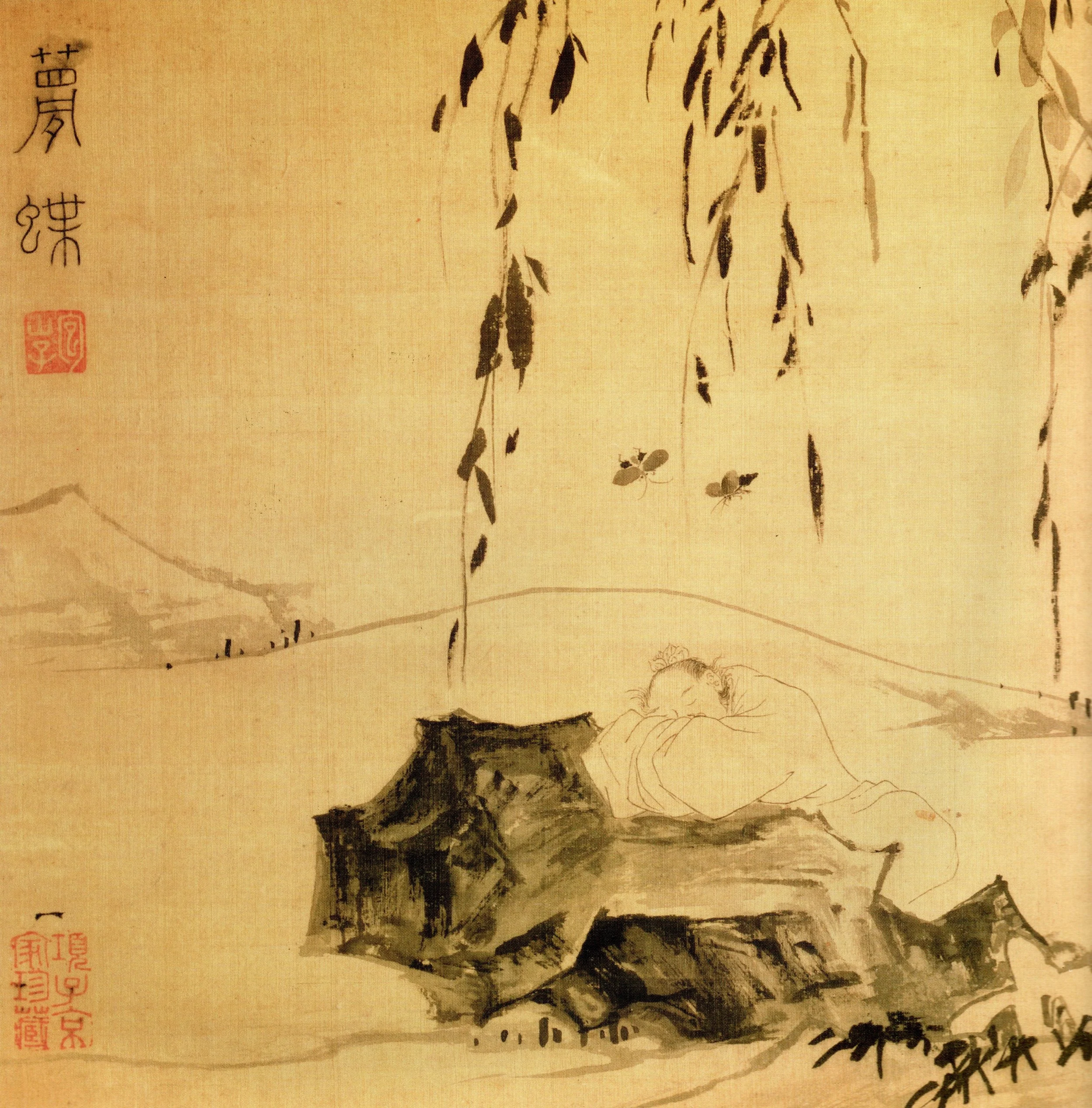
The Butterfly Dream, Lu Zhi (c. 1550)
“Row, row, row your boat, gently down the stream; merrily, merrily, merrily, merrily, life is but a dream!”
“All of existence is imagination within imagination.”
I take a seat in the cafe – the only empty spot. I recognize the woman to my left – her family are regulars. After I finish my coffee, I turn and ask if her family is connected to the university. She says, “Yes, my husband is a PhD student.” I ask what subject. “History.” “What specialty?” She pauses, “Islam in West Africa.” I share that I am interested in his field of study and she offers his email address. I head to the library. And begin writing this entry.
Yesterday I sat in this same library chair. Writing a draft for these Field Notes. I wanted to convey my appreciation for an interview with Oludamini Ogunnaike in the Journal of Contemplative Studies. He is a professor at the University of Virginia and his area of expertise is Sufism in West Africa.
A passage in the interview struck a chord for me. Ogunnaike shared that his teacher described life as dreamlike. I had first encountered Ogunnaike in 2021 through his paper comparing Ibn ‘Arabi’s metaphysics to Christopher Nolan’s film Inception. Ogunnaike wrote that the British-American film director and the Andalusian mystic both articulate a vision of life as a dream within a dream.
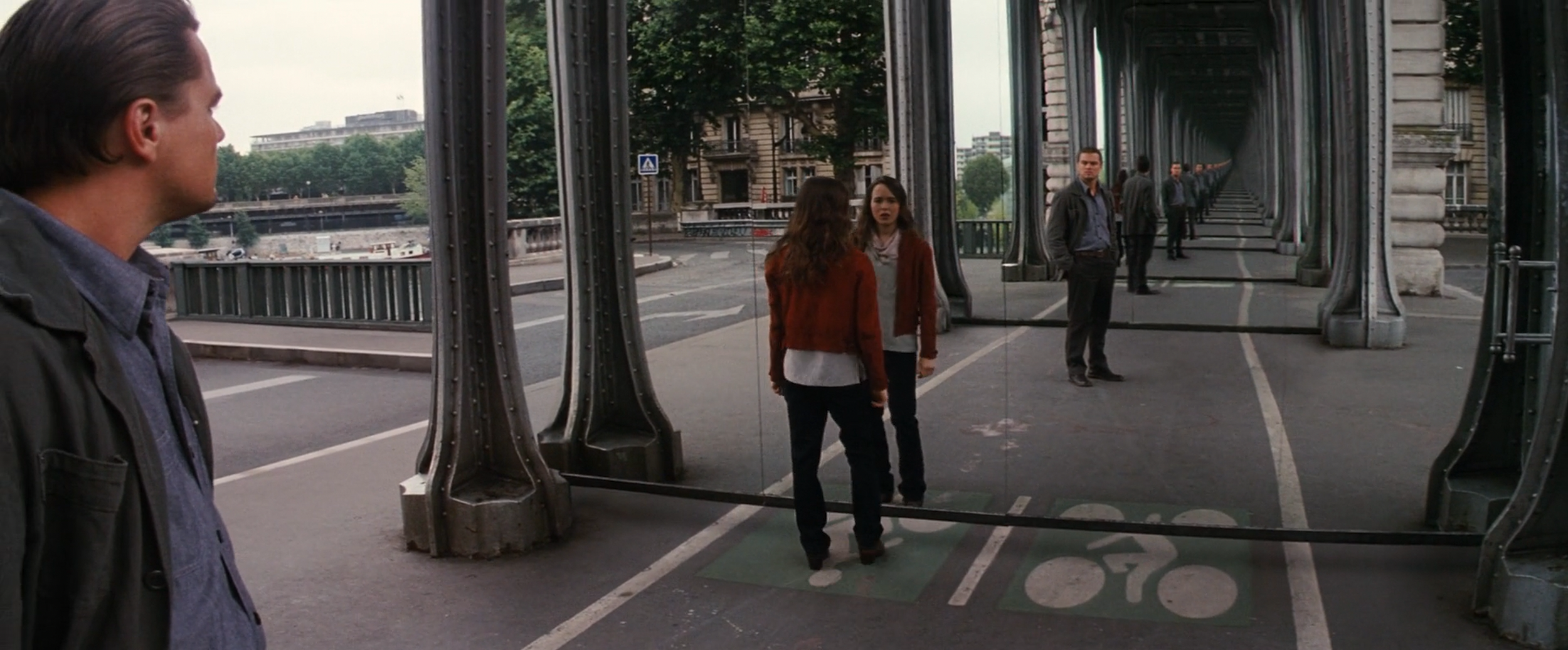
Inception (2010)
Engage in the contemplative practice of ally work consistently – a practice of active imagination developed by Jeffrey Raff in the Jungian alchemical tradition – and the experience of life as dreamlike may present itself to you.
I have practiced ally work both consistently and in lapsed fashion. When my practice has been steady and alive, synchronicities present themselves to me at a heightened degree. It is not a subtle effect. It is quite evident.
Synchronicity is Carl Jung’s term for the unexpected coincidence which has meaning for us. Wolfgang Pauli, who received the Nobel Prize in Physics, and explored the imaginal with Jung over decades, suggested an alternate term. He offered the word isomorphy – the structural similarity or identity of forms. Pauli’s intention was to free the concept from being bound by simultaneity.
Isomorphy has significance in scientific domains such as mathematics and crystallography. Isomorphy presents itself in repeating patterns and orders. Pauli understood the subjective experience of isomorphy – of synchronicity – as pointing to a deeper order of being that is hidden to the eye.

Crystal structure of Vitamin C, Justin Zoll.
I couldn’t tell you exactly how synchronicity functions in relation to ally work – I don’t have a quantitative model. But I have experienced it again and again. Anecdotally, other practitioners in the community I host at AllyWork.org share this experience too. It appears to be a common experience in relation to the practice. Ally work amplifies the presence of synchronicities in one’s life.
This is a strange and mysterious matter. How does engaging in an inner dialogical practice with one’s ally elicit an amplification of synchronicity in the outer world?
In my opinion this experience – this phenomenological response – points to the imaginal nature of our existence. It points to what the teacher, the filmmaker, and the mystic saw in describing life as like a dream.
When in practice we center ourselves, and then deepen into the imaginal dialogue with the ally, you might say that we enter an imaginal current, or stream, that is ontological in nature. It is a living dimension of reality whose metaphysics are more fluid and dynamic than the sensible realm we witness in our daily life. The imaginal world is not limited by conventional models of cause and effect. It is more akin to the models we see in the quantum domain, which point to nonlocal effects and relationships.
In the opening prayer of his Awrād al-usbū‘, his book of daily prayers, Ibn ‘Arabi gives us a perspective on how the spiritual domain is ordered and functions. He writes, “[I ask Him for] A mind that is illumined by the providential grace of recognizing His Foreknowledge.”
Could this be a clue to what we encounter in the presence of synchronicity? Could we understand synchronicity through Ibn ‘Arabi’s lens of illumination, providential grace, and Foreknowledge? Could the phenomenological experience of synchronicity be a resonance of deeper, eternal truths? Could we see Pauli’s isomorphy in this light as pointing to a structural harmonic resonance between visible and invisible worlds?
Pauli, in the course of his contemplative explorations, once wrote, “Each natural law should then have an inner correspondence and vice versa, even if this is not always immediately visible today.”
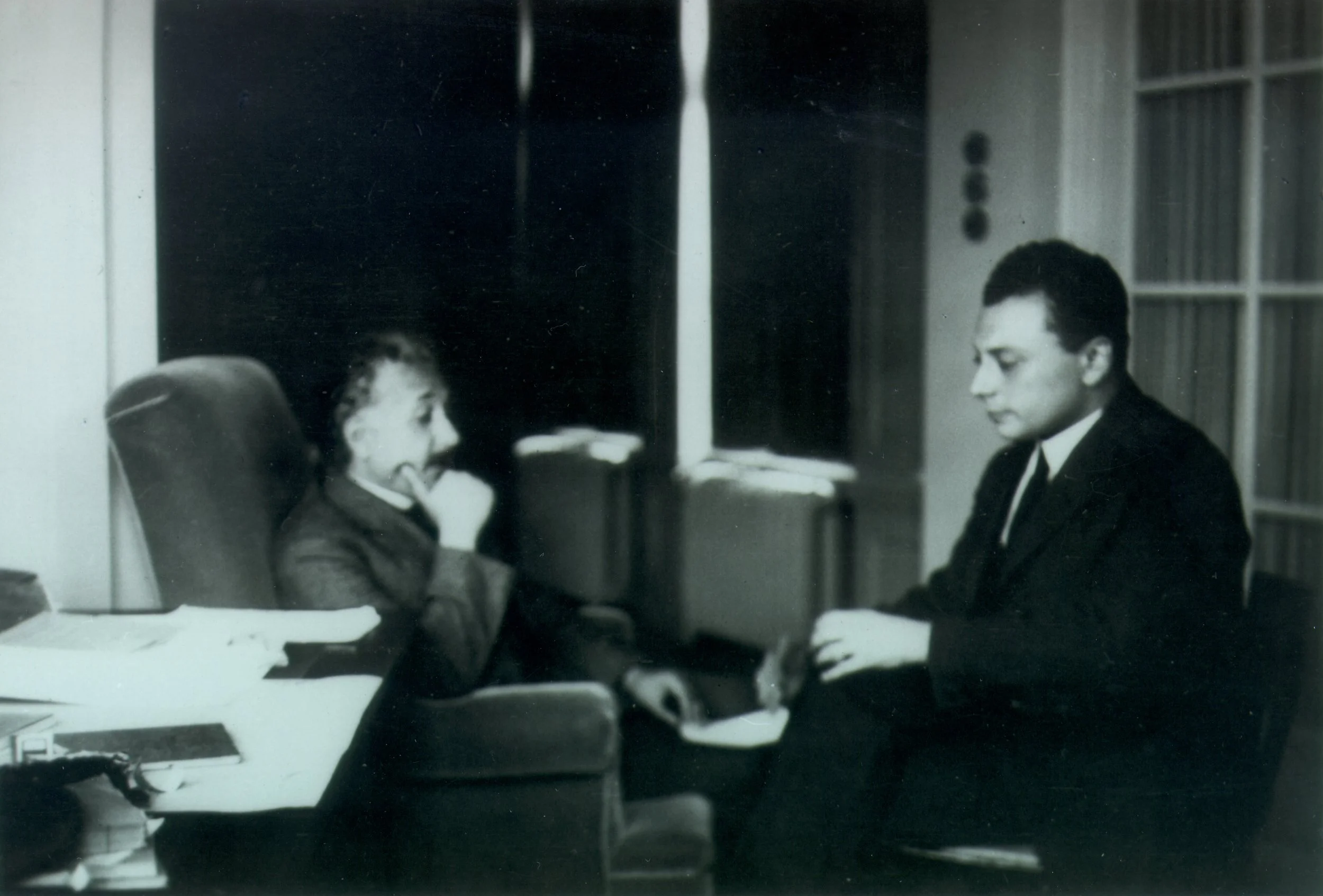
Albert Einstein and Wolfgang Pauli working together, 1926 (CERN)
In the daily existence of modernity – conditioned deeply by materialist assumptions – we are often veiled to the imaginal and spiritual dimensions of being. We do not see how these deeper ontologies are always existing – and sustaining – who we are.
Ally work is a contemplative practice that re-opens our connection to the imaginal. I value it for both its accessibility and its depth. When we proceed with humility and care in the practice, we consciously re-integrate the multidimensionality of our being that we have been conditioned to ignore.
My personal background includes exploring Buddhism in Rinzai Zen monasteries and teaching mindfulness in public high school classrooms. I’ve spent weeks at a time on silent meditation retreats – both as a student and a teacher. When I reflect on my experience, I could make the case that meditative practices are practices of knowing who we are. When I consider ally work in relation to these practices, I wonder if ally work might be a practice of knowing who we can be?
Meditative practices are ultimately about knowing who we are as the ground of being – as nondual awareness itself. Ally work is about knowing who we are in uniqueness in that ground of being. Ally work helps us integrate what we might call our generalized unity with our individualized unity. Meditative practices help us recognize our true nature as life itself. Ally work – in engaging with the active imagination – helps us translate who we are into the creative potential of who we might be. To put it in Ibn ‘Arabi’s language, imaginal practice helps us live the creative potentiality of who we are in the Foreknowledge of the Divine.
These are Ogunnaike’s words in the interview that struck a particular chord with me:
So, I’m looking at how we might perceive the world as poetry and how we might move through a world in which everything is a sign, a metaphor. In a sense, everything is a dream, but it’s not like The Matrix, where you’re supposed to wake up and just get out of it. Instead, it’s like a poem you enjoy. It’s art. It’s an artifice, but one created with intention. It’s like an overflow of reality – you try to recognize it for what it is, understand its deeper meanings, and bask in this reality, not run away from it.
Then he reflects on the challenges that come with this way of perceiving poetically:
But this can mess you up. The analogy that one of my teachers uses is birds flying into windows. The world is like that, a fun house of mirrors. You see the beautiful face of the Divine reflected everywhere, but if you just run toward it at full tilt, you’re going to keep smacking into it. You’re not going to get to kiss your beloved. So you have to learn to navigate the world of reflections of Divine Beauty.
While not all of us have been formally introduced to the languages and practices of the imaginal, we all are deeply experienced in encountering the imaginal through the world of dreaming.
Many years before I’d heard of the imaginal I had a deep dream. I call it a dream, but given its meaning for me, I could call it a personal vision. In the dream I was in a space, a corridor, a passage, where people were coming and going. I stood in the midst of the movement of the crowd and the flow of people. I call it a deep dream because it came with a deep insight for me – which I will try to express as follows:
One’s calling was simply to respond to the calling of the moment. Turning here, turning there, meeting the need.
It was a vision of a life so much more fluid, dynamic, and responsive than the ego-driven life – the life dictated by the conditioned stories about who we are and who we can, or can’t be.
You will know this yourself. Dreams aren’t impersonal, they are as personal as can be. I woke up one morning from that dream but it still lives vividly within me.
What are dreams communicating to us in their deepest capacity? We might pay heed to a key insight that Ibn ‘Arabi offers us – which I paraphrase: God talks to you in the language you understand.
For me, this insight is also a way to understand ally work. We can understand ally work as a practice – the formal contemplative structure of engagement. We can understand ally work as a relationship – the relationship with the ally. We can also understand ally work as a language – you could say we are learning a language in which God can help us understand.
In a period of steady imaginal practice, when I am working on the post on Ogunnaike one day, and meeting the wife of the scholar of Islam in West Africa the next, the synchronicity gives me delight and inspiration. It helps me taste a deeper reality – a deeper love and support – which I do not always perceive.
Like when my mother picks up the phone and says, “I was just thinking of you.”
How do we distinguish between true dream and synchronicity, and errant fantasy – wishful thinking? Through discernment, through practice, through trial and error. By engaging in the contemplations of who we are and who we might be.
And what happens when we do this together? That’s what especially interests me. Ally work as individual, beautiful. Ally work in collective, helpful. Perhaps a little less flying into windows.
A few years ago at Stanford University I attended a seminar offered by Ogunnaike, “Ibn ‘Arabi and the Paradoxes of Love.” At one point in the discussion I asked him, “Does God speak through other people?” “Of course,” he said.
This is why we are here at Contemplative Labs – to gather and commune, to celebrate and support, to struggle and bear witness – knowing that you and I, us, we – are waking together in this dream.
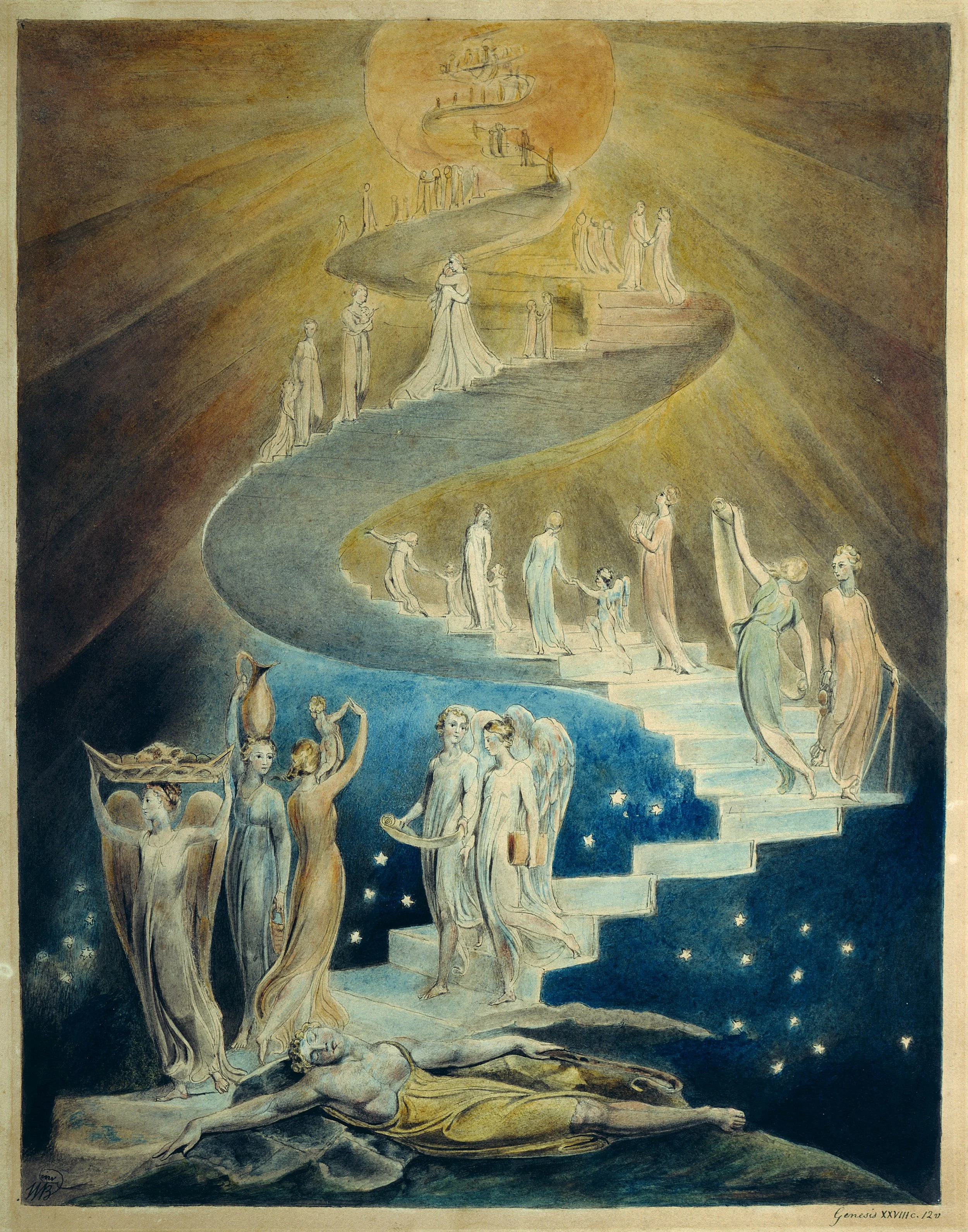
Jacob’s Dream, William Blake (c. 1800)
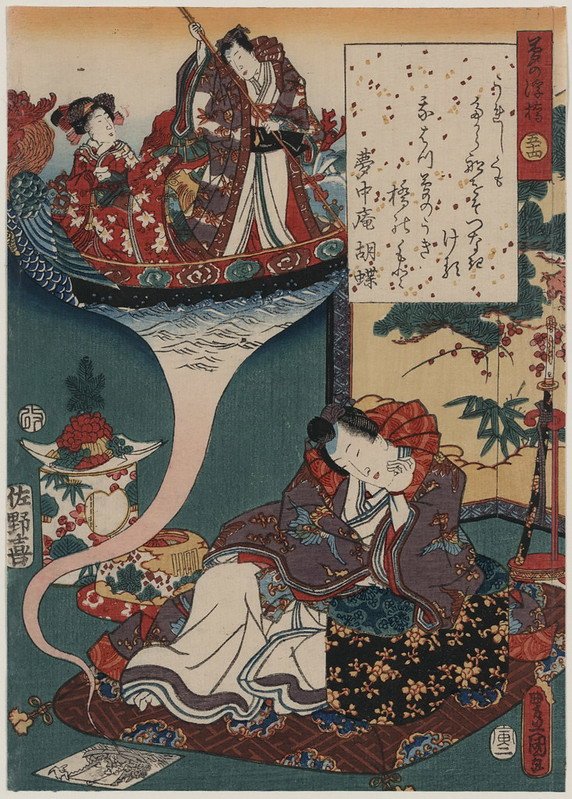
The Bridge of Dreams, Utagawa Kunisada (1854)